Witnessing
Visual Art Projects
Escapism
Documentary photography project
Relate Art Residency, supported by the European Union
2024-2025

© Oksin
What does it mean to escape? A fleeting breath, a desperate flight, or a quiet rebellion?
Escapism is often perceived as an attempt to avoid reality. Yet it can also be a necessity, a form of resistance or a response to circumstances beyond our control.
My personal experience of displacement has led me to question the different meanings of escape. A chance encounter on a train in Switzerland brought these reflections into sharper focus. I met a young man who had been forced to leave his country under difficult circumstances. Without documents or knowledge of foreign languages, he travelled across borders before eventually reaching a place where he could begin rebuilding his life.
His story inspired me to collect personal accounts of displacement through interviews. As I listened to different experiences, I began to realise that escaping physical danger does not necessarily mean escaping its psychological consequences. Crossing a border may bring someone to safety, but it also places them in an unfamiliar reality, where language, culture and even one’s sense of identity must be renegotiated.


An installation composed of military storage boxes containing my personal belongings, presented as part of Transformative Worlds, an exhibition in which I introduced my documentary project Escapism. Limassol Municipal Art Center – Apothikes Papadaki, Cyprus.
Curated by Yorgos Taxiarchopoulos
Photograph by Yiorgos Stylianou
At the same time, I became interested in less dramatic forms of escapism: the small, voluntary retreats through which people distance themselves from overwhelming realities. For some, it is gardening, art or familiar routines. For others, it is helping people facing similar circumstances.
The contrast between these experiences reveals a fundamental contradiction: for some, escape is a privilege; for others, it is a matter of survival. While one person seeks temporary relief from everyday pressures, another is forced to abandon an entire life.
The project explores this tension between physical escape and psychological escapism, examining how personal responses to adversity reflect broader social, cultural and political conditions.
When does escapism cease to be an individual choice and become a consequence of circumstances beyond our control? Where is the boundary between necessary withdrawal and deliberate avoidance?
Ultimately, escapism is not an answer but a question.
Is it a sanctuary or a trap? A necessity or a privilege? Are we escaping towards something, or merely running away from what we cannot confront?
Being-in-itself
Installation. Larnaca Art Biennale. Cyprus
2023

© Oksin
Being-in-itself. A pile of rich, black soil—known as “chornozem” in my native Ukraine—is a powerful symbol of my country, my roots, and the life I once knew.
The words surrounding it—“Source”, “Soil”, “Dust”, “Mud”, “Earth”, “Property”, “Home”, and “Land”—reflect the different meanings this soil can hold, shaped by each person’s experience. The work draws on Immanuel Kant’s notion of the “thing-in-itself”: an object as it exists independently of our perception or representation of it.


© Oksin
Our perception, however, is never independent. It is shaped by our feelings, beliefs, knowledge, and experiences. For me, the smell of wet soil after rain evokes an immediate sense of home, regardless of the country I am in.
Although restrictions on importing soil and agricultural products into the European Union prevent me from recreating the Chornozem installation in its entirety, I still carry a handful of rich, black Ukrainian soil. This gesture follows an old tradition: taking a handful of soil on a long journey as a keepsake, carrying a part of one’s homeland. If the traveller dies abroad, that soil is placed in their grave—“earth to earth, dust to dust”.
Soil, earth, and the Earth itself mean more to me than a point on a map marking my location. I carry my earth with me, and the Earth carries me. We coexist.
Human without skin
Embroidery on a bodysuit. Limassol carnival. Cyprus
2023

© Oksin
Human Without Skin is a textile work that traces the body’s internal structures through intricate embroidery on a garment-like form. Veins and nerves emerge in thread, exposed and unprotected, as though the skin has been peeled away.
The figure is laid bare: raw, vulnerable, and painfully honest. Its anatomy becomes an expression of the emotional dissonance I experience while living in safety as war tears through my homeland. Surrounded by carefree faces and casual conversations, I feel like a body without skin—every nerve exposed, every emotion intensified. I am not okay, and I refuse to pretend otherwise.
The work is a quiet protest against the pressure to appear unaffected. It does not seek to disturb another person’s peace, yet it refuses to conceal pain for the sake of their comfort. It asks how we can coexist when our realities differ so profoundly, and how we can sustain empathy when suffering feels distant.
Human Without Skin reminds us that beneath every surface lies a story—sometimes bleeding, sometimes trembling, always alive.
White Spots
Oil paintings. Jan Garemijnzaal, Brugge, Belgium
2022

Self-portrait, oil on canvas, 100x100
© Oksin
Soldiers, oil on cardboard, 100x80
© Oksin
White Spots is a deeply personal attempt to piece myself back together—and perhaps help others do the same—in the aftermath of the shared tragedy we experienced during the early months of the full-scale invasion. I never intended to exhibit these paintings. They began as private reflections, created in solitude. Gradually, however, they found their way into public view.
The paintings capture fleeting moments in the lives of Ukrainians: scenes that have become part of a harrowing everyday reality, yet rarely reach the headlines. These are the “white spots” in our collective memory—the experiences left unrecorded, the voices lost in the noise. I believe each of us carries such stories, still unfolding and waiting to be told.

Soldiers, oil on cardboard, 100x80
Exhibited at Jan Garemijnzaal, Brugge, Belgium
© Oksin

Refugee, oil on canvas, 100 × 100 cm
Exhibited at Limassol Municipal Art Center – Apothikes Papadaki
Photograph by Yiorgos Stylianou
Two paintings from this series were first exhibited at Jan Garemijnzaal in Bruges, Belgium. Works from the series were subsequently shown at the Ukrainian House in Paphos, Evoke Artist-Run Space in Larnaca, and finally at the Limassol Municipal Arts Center – Apothikes Papadaki, all in Cyprus.
Among the works are two square self-portraits. The first, Refugee, is vivid and chaotic. Its background draws inspiration from Natalya Serhiyevna, a homeless woman who lived in my neighbourhood in Kyiv. She spoke coherently, yet believed she was a theatre and film actress from Buenos Aires. Her clothes and bags were decorated with handmade flowers and bows fashioned from colourful plastic.
When I arrived in Cyprus, displaced and weighed down with bags, I recognised something of myself in her: an eccentric woman telling everyone she was an artist. The distance I had imagined between us disappeared. I thought: I am her.
The second self-portrait is darker. It expresses the raw, corrosive hatred I felt towards the enemy—an emotion so intense that it threatened my own sense of humanity. The painting raises a question I continue to struggle with: how do we remain human in the face of madness?
War is relentless. Each moment brings tragedy, courage, and quiet acts of survival. Countless stories are witnessed by only a few people, yet together those people make up a nation. A young man, barely an adult, caught in the battle for Hostomel. A mother sheltering in a basement in Bucha. Someone held captive, or haunted by the sound of enemy boots. Survivors living with wounds that cannot be seen.
The scale of this suffering is overwhelming. It can make an individual life feel insignificant. Yet that feeling is misleading: the magnitude of the tragedy does not diminish the value of any person within it.
There are tensions among Ukrainians—resentment towards those who left, those who appear indifferent, or those absorbed in their own struggles. It is easy to see others as the “wrong” kind of people. But when we turn from categories to individual lives, from assumptions to faces, we begin to recognise one another’s humanity again.
Everyone has the right to feel despair and anger. What matters is that we remain connected, listen to one another, and make room for experiences different from our own. Through compassion and mutual support, we can find strength together. Even when we cannot change our circumstances, we retain the freedom to decide how we respond.
Self-reconstruction with AI
2022


This digital experiment explores the tension between identity and algorithmic interpretation. Beginning with a self-portrait, I initiated a recursive cycle of erasure and regeneration: first removing half of my face and allowing AI to reconstruct it, then switching sides and repeating the process. With each iteration, the portrait became less mine and more machine — a gradual unraveling of human likeness.
By the seventh cycle, all recognizable traces of a face had vanished and a window with the inscription "Generated images violate user guidelines" appeared on the screen. The work questions the boundaries of authorship, the fragility of self-image, and the point at which digital mimicry overtakes human essence.
Crown of Thorns
Art object. IT Forum, Kyiv, Ukraine
2021

Photograph by Alex Zakletsky
Created during the COVID-19 lockdown, Crown of Thorns combines twisted-pair communication cables with hypodermic needles. These materials bring together two defining aspects of the pandemic: our reliance on technology to maintain human connection and the medical realities shaping our daily lives.
The work draws on the Christian image of the crown of thorns, a symbol of suffering, sacrifice, and faith. Recreated from contemporary materials, it connects this religious imagery with the vulnerability and uncertainty of the pandemic. During a collective crisis, we ask ourselves where we place our trust—in faith, medicine, technology, or one another.
Through this work, I reflect on the profound challenges of staying socially connected during isolation. The cables evoke the digital networks that sustained our relationships, while the needles suggest both medical care and bodily vulnerability. Together, they form a symbol of the transition into an era increasingly shaped by digital media.
Made in Chornobyl
Documentary art project. Kyiv History Museum. Ukraine
2019

Details of the art installation
© Oksin
Made in Chornobyl brings together photography, installation, video, and painting created during an artist residency in the Chornobyl Exclusion Zone.
I chose an ordinary, familiar object: a three-litre glass preserving jar filled with water. The jar acts as a lens, distorting whatever is seen through it. Through this “looking glass”, the landscape becomes misshapen, unsettling, or strangely beautiful. Such unexpected beauty can emerge when we look beyond familiar perspectives and accepted conventions.
In a sense, Chornobyl itself resembles this jar: a sealed, contained space that evokes pain, fear, bitterness, and compassion. Walking through Prypiat and the abandoned villages feels like entering a post-apocalyptic landscape, where tragedy has permanently altered our perception of reality.

Amusement park and street view in Prypiat, Chornobyl Exclusion Zone
© Oksin
At the time of my residency, thirty-three years had passed since the evacuation. Nature was gradually reclaiming buildings, streets, and cultivated land, obscuring the traces of human habitation. The Zone had become a refuge for wildlife, including moose, lynx, eagle owls, Przewalski’s horses, and wolves. Dense vegetation was replacing the orderly rows of planted trees. Life continued largely without us, yet human experience remained central to how this landscape was understood and remembered.

Exhibits, prints on textile, 100x 76
© Oksin
During the residency, we followed a simple rule: everything brought into the Zone had to be taken out again. Workers and residents used reusable containers, and I was struck by the absence of the roadside rubbish I had encountered elsewhere. In a place so profoundly marked by human intervention, these everyday acts of care felt especially significant.
When we needed water for painting outdoors, a worker at a Chornobyl café offered to seal it in large preserving jars. This familiar object, so closely associated with Soviet domestic life, became the starting point for my printed textile series, Exhibits.
Noumenon
Collaboration with Ave Libertatemaveamor
Rymi Art Gallery. Ukraine
2019

Hand-painted three-dimensional compositions or ready-made objects
© Ave & Oksin
2019
Noumenon is a conceptual art installation that interrogates the boundary between perception and reality. Composed of familiar objects stripped of their conventional function and meaning, the work invites viewers to confront the illusion of significance that arises when essence is lost. What remains is not absence, but a haunting presence — a suggestion of something beyond comprehension.
Inspired by Immanuel Kant’s notion of the thing-in-itself — the noumenon — the project reflects on the impossibility of truly knowing the essence of objects beyond our sensory experience. As Kant wrote, “Knowledge refers to phenomena, and things in themselves remain incomprehensible.” This philosophical tension becomes the foundation for a visual meditation on pure reason and its antinomies.
The artists draw further influence from Hermann Hesse’s The Glass Bead Game, engaging in a symbolic “play” that reimagines corporate aesthetics and artistic language. Through monochromatic graphics and ambiguous visual narratives, the installation unfolds without a clear origin or conclusion. Each symbolic image opens a new associative pathway, challenging the viewer to navigate meaning without the anchor of familiarity.
Noumenon is not a search for answers, but a confrontation with the unknowable — a poetic gesture toward what lies beyond the veil of perception.
Katherines
Documentary photography project. National center "Ukrainian House"
2017-2019

Inspired by Taras Shevchenko’s poem Kateryna, I set out to reconsider the fate of modern-day “Katherines” through critical metaphors and documentary observation.
Travelling through forgotten Ukrainian villages, I encountered the women who became the heroines of my project: mothers living in poverty, raising more children than they could afford to support.
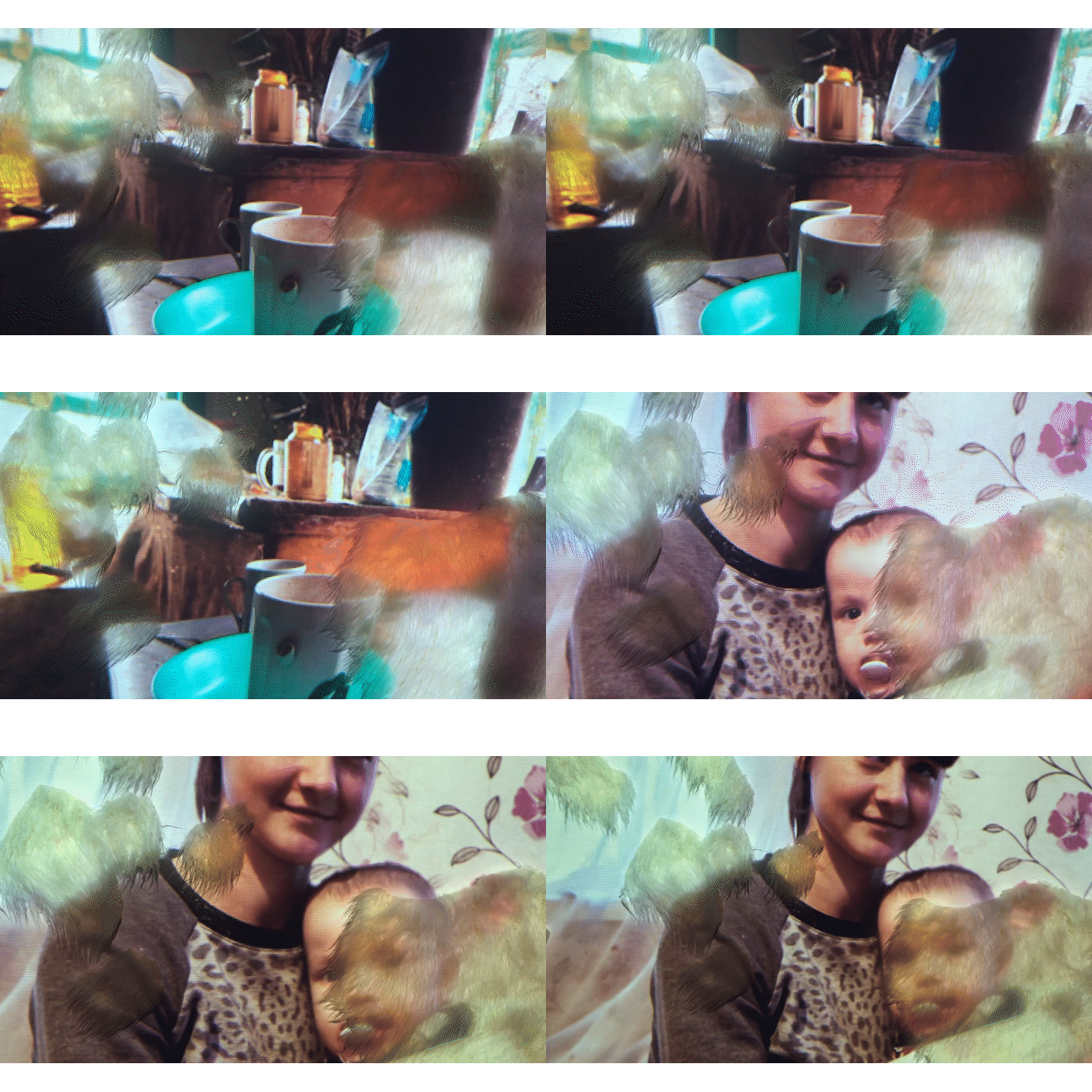
Katherines video-installation, Photo-motion, white screen, projector, faux fur, fan
© Oksin
I was struck by a troubling contradiction. These women seemed trapped in a destructive “comfort zone”, clinging to patterns of behaviour that perpetuated their hardship. What appeared to be an unwillingness to change, however, was difficult to separate from the circumstances in which they lived. Isolation, limited access to information, and a lack of opportunities made breaking these patterns extraordinarily difficult.
Where does personal responsibility end and social circumstance begin? The project explores this uneasy boundary, questioning how much freedom of choice remains when the possibilities for change are so limited.
Foodstuffs portraits
Series of shawls. Modern Art Research Institute of Art Academy of Ukraine
2019

Series of shawls. Digital fabric printing 100x76 cm
© Oksin
I have always been fascinated by how little information we need to form an opinion about someone. Even the assortment of groceries on a supermarket checkout conveyor belt can become an instant portrait of a complete stranger.
Imagine two loaves of bread, a bottle of vodka and a tin of baby formula. We know absolutely nothing about the person buying them, yet our imagination immediately starts constructing a story. Is there a problem with alcohol? Is there a baby at home? Or are we simply projecting our own prejudices?
One assumption leads to another, and before we know it, we have invented an entire life for someone we have never met. What interests me is how much these imaginary portraits reveal about ourselves: our experiences, cultural backgrounds, fears and personal biases.
This moment of judgement raises a broader question for me: what can art actually change? I don't believe that art alone can make us better people or more responsible citizens. Our attitudes and values are shaped by a much more complex combination of influences: family, education, social environment, cultural expectations and the information we consume.
Yet art has its place within this system. It can draw our attention to things we normally overlook, challenge our assumptions and raise questions we might otherwise avoid.
With Foodstuffs Portraits, I am not trying to teach anyone a moral lesson. I am more interested in that brief moment when we catch ourselves making a judgement and begin to question why.
Womb
Video-installation. Modern Art Research Institute of Art Academy of Ukraine
2018

“Womb” — A Sanctuary of Sound, Flesh, and Memory
In my video installation Womb, I invite viewers into the most intimate and inaccessible space of human existence: the uterus. Created during my pregnancy, the work combines recordings of my son’s heartbeat with an imagined interior of the womb, painted as I envisioned it from within. Through image and sound, I attempt to recreate a space we have all inhabited but none of us can remember.
At first glance, Womb appears to celebrate motherhood and the miracle of life. Yet beneath this familiar narrative lies another, less romanticised reality: pregnancy and childbirth as experiences of profound physical vulnerability, pain and transformation. While motherhood is surrounded by cultural ideals of love, fulfilment and sacrifice, the biological reality of giving birth is often overshadowed by its symbolic significance.
Human evolution has made childbirth particularly demanding. The anatomical constraints of upright walking, combined with the relatively large heads of human infants, contribute to the complexity and risks of birth. What we tend to regard as the most natural event in the world is also one of the most physically challenging experiences the human body can undergo.
At its heart, however, Womb is an exploration of solitude. Pregnancy and childbirth may be shared emotionally, witnessed and supported by others, but the physical experience remains profoundly individual. No one else can inhabit the transforming body, endure its sensations or experience its vulnerability from within.
The installation invites viewers into this private space, where a recording of my son’s heartbeat, made during my pregnancy, now surrounds strangers. What was once an intimate rhythm shared between two bodies becomes an experience accessible to others.
Womb exists within this contradiction: the intimacy of creation and the isolation of the body, the wonder of new life and the physical cost of bringing it into the world.